
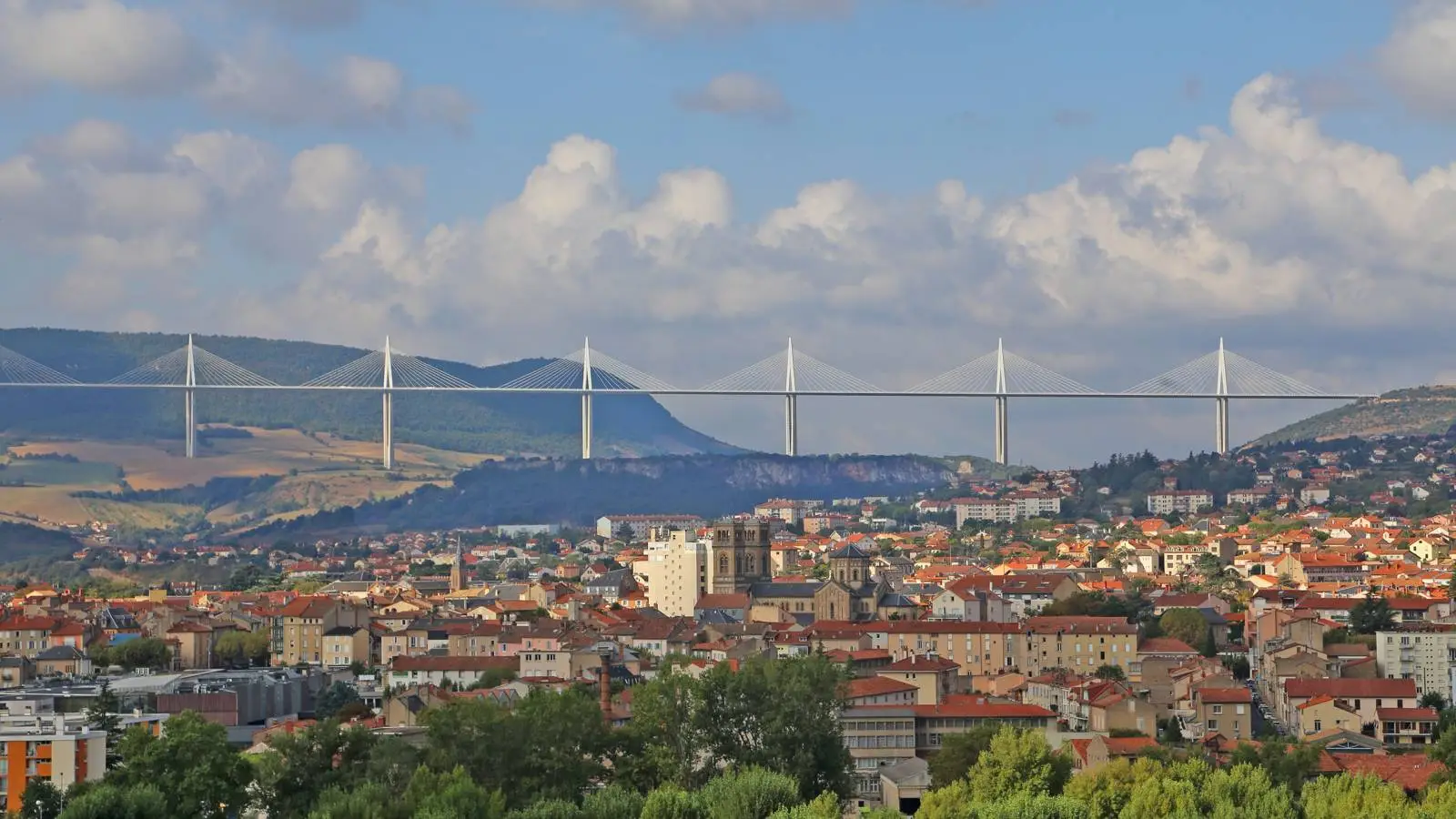
Discover the Millau Viaduct, the world’s highest bridge in France: record-setting design, purpose, cost, and what to see—from viewpoints to tours on site.
In southern France, amid rolling hills and valleys, stretches a bridge that does more than link two banks—it captures the imagination. The Millau Viaduct is a record-setter and a feat of engineering worth seeing at least once.
The Millau Viaduct isn’t just lofty—it holds the world height record. Its piers rise to 343 meters, higher than the Eiffel Tower. The roadway crosses the Tarn Valley at roughly 270 meters, and as you drive over it, the experience borders on flight.
Spanning nearly two and a half kilometers, the viaduct is composed of seven spans, the longest reaching 342 meters. At about 32 meters wide, it carries traffic smoothly in both directions. Architect Norman Foster and engineer Michel Virlogeux joined forces on a design that looks weightless yet stands up to immense loads—an elegant balance that’s rare and deliberate.
Before the viaduct, travelers heading from northern France to the Mediterranean routinely hit gridlock in the town of Millau, especially in summer when the traffic could grind to a halt. The new crossing solved that bottleneck: it became part of the A75 expressway and noticeably shortened the journey.
Preparation took more than 13 years. Construction began in 2001 and wrapped up in 2004. The opening was held on December 14, and two days later the first cars were already crossing. The total cost came to around 400 million euros.
The viaduct quickly became more than a road—it turned into an attraction in its own right. Visitors come for the viewing platforms, the exhibition center, and a walking trail that runs beneath the bridge. There are guided tours, museums, and even special races across the viaduct every two years. It’s difficult to leave without a sense that infrastructure can have a pull of its own.
In 2006, the bridge received a prestigious award recognizing it as an outstanding structure. Since then, it has been profiled in magazines, featured in films, and regularly placed on lists of the world’s most striking bridges.
Millau is not just a way to cross a valley. It’s a clear example of how beauty, utility, and technology can align. It eases daily life for locals, draws visitors, and gives engineers something to aspire to—projects like this hint at the shape of future cities.
If you find yourself in this corner of France, don’t just drive past. Even if you’re neither an engineer nor a traveler with a camera, this viaduct has a way of making you slow down and look up. Structures like this are rare—and they tend to stay with you.