
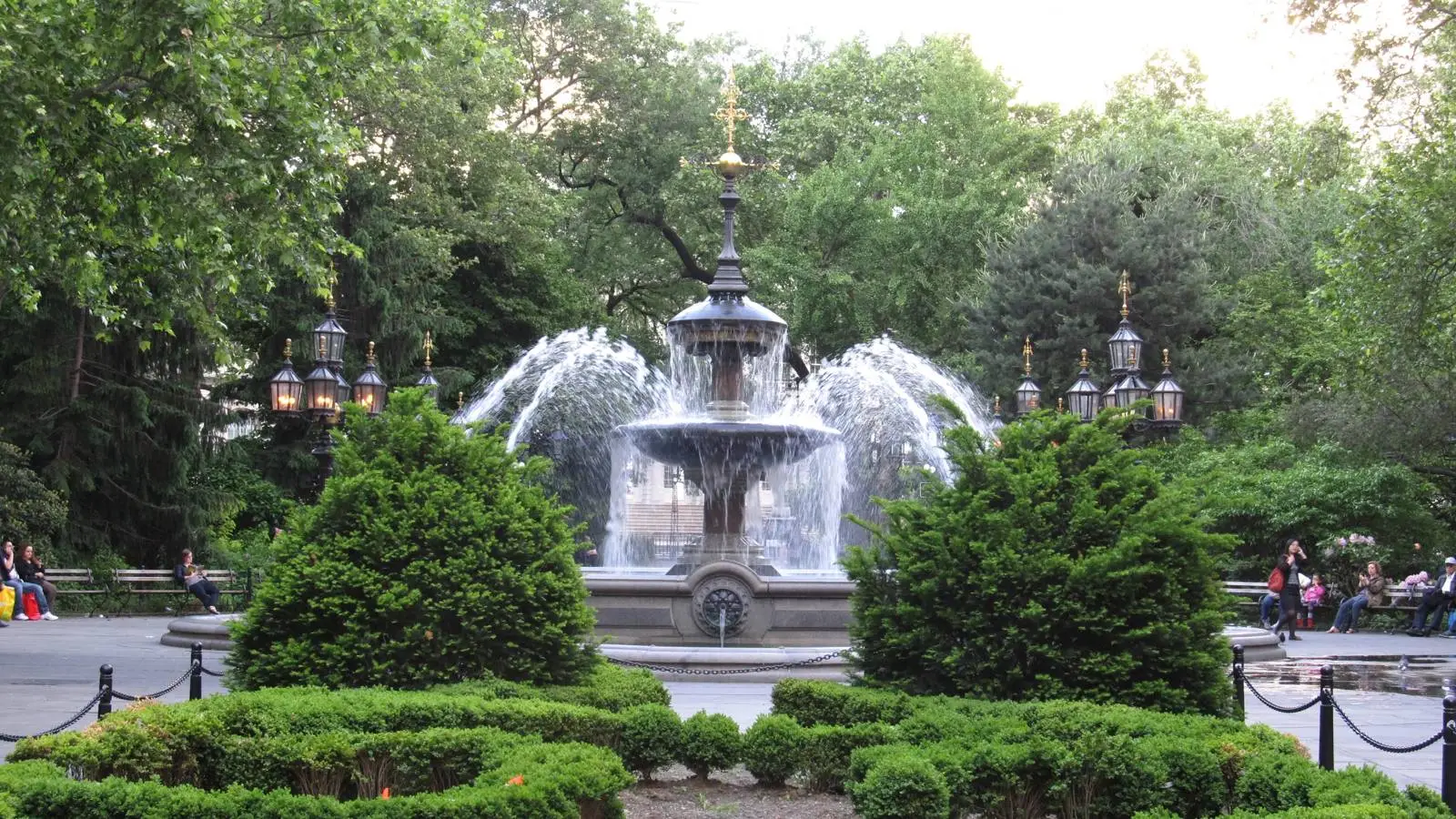
Discover the hidden histories of New York fountains—from Riverside Park to Bryant Park and Pulitzer Fountain—scandals, tragedy, and if you can swim in them.
In New York, fountains are hard to miss—they line many streets and plazas, brighten parks, and offer a welcome splash of cool on hot days. Yet behind all that sparkle sit stories you might not expect.
In Riverside Park at 76th Street stands a modest fountain dedicated to Robert Ray Hamilton. Once a noted politician and a relative of Alexander Hamilton, he met a tragic end: his wife deceived him by faking a pregnancy and was later implicated in a killing. Hamilton himself died under strange circumstances in Wyoming. The fountain went up after his death, in 1906—a quiet marker for a life that unraveled so publicly.
Farther north in the same park, near 100th Street, the firefighters’ memorial is adorned with a sculpture for which Audrey Munson posed—one of the most famous models of the early twentieth century. She became known as the American Venus and sat for many sculptures across the city. Her own story, however, ended in a psychiatric hospital, where she spent more than 60 years. The contrast between the city’s admiration and her fate still feels jarring.
At the south end of Bryant Park stands a fountain honoring Josephine Shaw Lowell, a woman who fought for the poor and for social justice. It was the city’s first monument dedicated to a woman. In winter, frost clings to the granite and gives it a distinct air—as if the stone were sifting through memories.
By the Fifth Avenue entrance to Central Park, a fountain features Pomona, the goddess of fertility. The sculptor at work on the piece died before it was completed. One wealthy woman, Alice Vanderbilt, disliked the statue so much that she changed her hotel room to avoid seeing it from the window—a tidy reminder that public art and private taste often collide.
Some New York fountains have even doubled as pools. In Washington Square Park in 1935, water was turned on specifically for bathing. Today, in most of the city’s fountains, taking a dip isn’t formally banned, but officials discourage it: the water may not be particularly clean, and the equipment can be damaged. In certain places, such as Bryant Park, swimming is outright prohibited.