
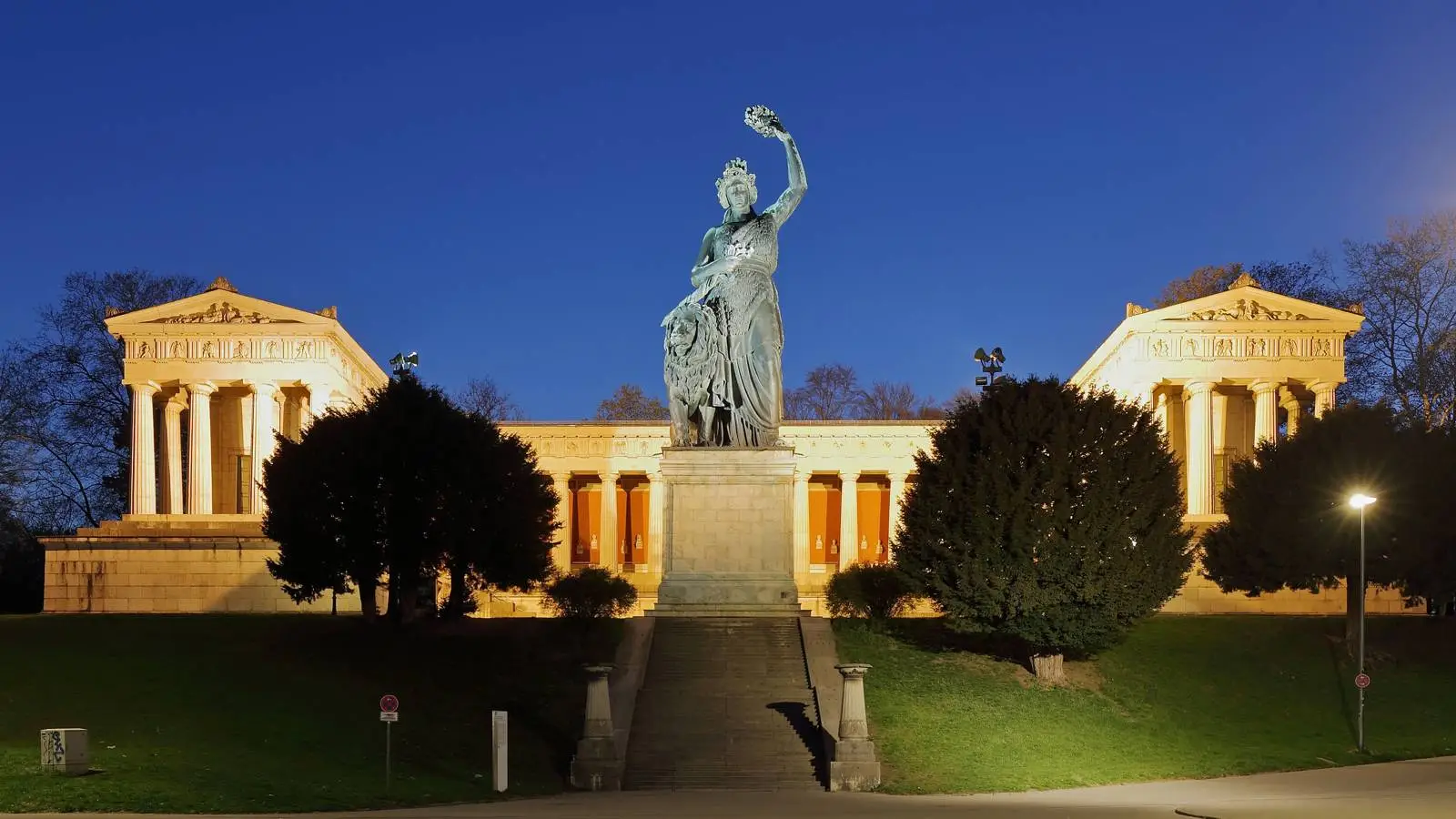
Discover Lady Bavaria in Munich: a 19 m bronze statue beside Oktoberfest with a staircase to viewpoints. Learn its history, hours (Apr–Oct) and entry €4–5.
Not far from the grounds where Oktoberfest unfolds each year stands a towering bronze woman. This is Lady Bavaria—more than a monument, a true emblem of the city. She’s so large you can actually step inside and take in Munich as she “sees” it, peering through tiny windows set in her head.
The idea for the statue came to King Ludwig I in the mid-19th century. He wanted Bavaria—the region in southern Germany—to have a symbol of its own. The commission went to renowned sculptor Ludwig Schwanthaler, and the statue was cast in Munich between 1844 and 1850.
For its time, it was a genuine feat of engineering: no one had attempted a bronze figure on this scale before. The gamble paid off, and Lady Bavaria has held her place for nearly two centuries.
Lady Bavaria is part of a larger architectural set. Behind her stretches a colonnaded gallery known as the Hall of Fame, lined with busts—sculpted portraits—of notable Bavarians. Together, they form a grand, dignified tribute to the region’s past.
The statue rises to almost 19 meters, or nearly 28 with its pedestal. It weighs more than 87 tons, all of it bronze.
The best surprise is inside. A spiral staircase leads up into the statue’s head, where four small windows open onto Theresienwiese—the very field where Oktoberfest takes place. On clear days, you can even make out the city center. There’s a quiet thrill in seeing Munich framed by those narrow panes.
The statue isn’t open year-round; visits run from April through October. Winter can be slippery and unsafe. Entry costs 5 euros, or 4 for students and seniors.
Lady Bavaria isn’t just a beautiful piece of sculpture. She’s a symbol of Munich and of Bavaria at large—appearing on postcards and in guidebooks, and often in the frames of tourists and reporters, especially during Oktoberfest. Millions pass her each year, though many don’t realize you can go in. Perhaps that’s the source of her pull: she’s not only something to look up at, but a figure you can encounter from within.
In many cities, monuments sit purely for show. In Munich, Lady Bavaria feels woven into daily life. You can step inside, see the city through her vantage point, and sense the spirit of another era. It isn’t a museum or an exhibition. It’s a meeting with history that feels disarmingly personal.