
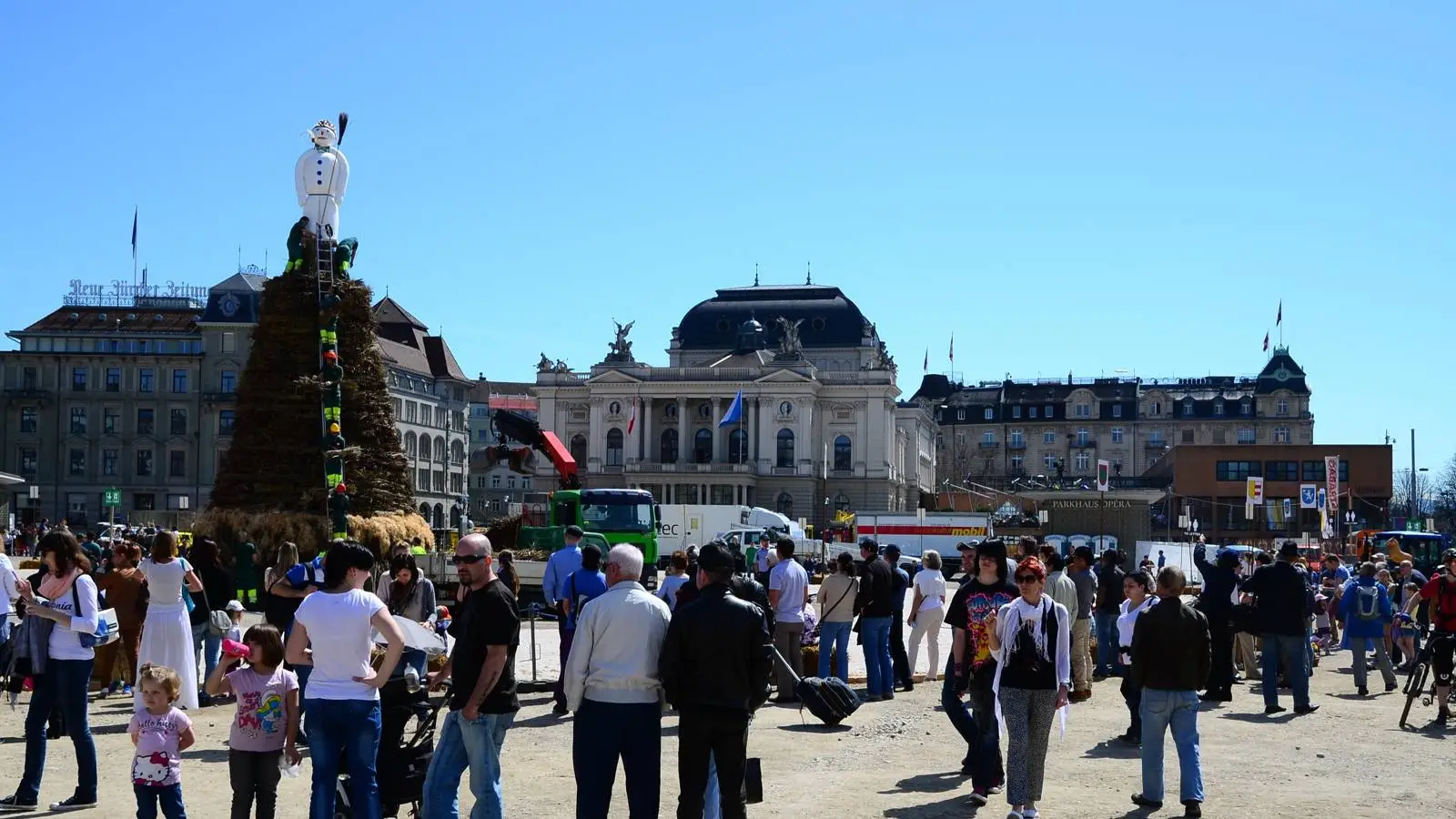
Discover Zurich’s Sechseläuten: the fiery Böögg burning that heralds spring. Learn its origins, how the timing hints at summer, and why locals still gather.
Every spring in Zurich, an unusual spectacle unfolds. In the city’s main square, locals set up a large effigy of a yeti known as the Böögg, build a towering pyre—and set it ablaze. The idea is simple: to glimpse what kind of summer lies ahead.
It may sound eccentric, but for Zurich residents this is a tradition with deep roots and its own meaning. And while the day looks festive, many watch the ritual in earnest, believing the Böögg can hint at the weather.
The Böögg is a large, doll-like figure made of wood, straw, and fabric. Its head is packed with firecrackers. In the past, such figures symbolized winter—or more broadly, fears—and burning them in spring was a way to drive the cold away.
At first, the burning of the Böögg was a separate event. In 1902, it was merged with the guilds’ parade—those historic associations of artisans—and together they formed a single spring festival Zurich calls Sechseläuten.
The festival is held in late April. The key moment comes when the pyre is lit and the Böögg begins to burn. People start timing: they measure the minutes from the first flames to the head’s explosion of fireworks.
The belief is straightforward: the faster the head explodes, the warmer and better the summer will be. If it takes a long time, summer is expected to be cold and rainy.
Over many years, plenty of timings have been noted. For example:
— In 1974, the head exploded after just 5 minutes and 7 seconds, and people say that summer turned out hot.
— In 2023, the Böögg remained silent for a record 57 minutes.
— And in 2025, the blast came at 26 minutes and 30 seconds, which is considered an average result.
Of course, no meteorologist uses the Böögg in their calculations. Still, the crowd follows the countdown with genuine interest.
Moreover, one Swiss study indicated that in some cases the time to the Böögg’s head exploding matched broader weather trends across the planet. That doesn’t make it a dependable forecast, but as a tradition, it does what traditions do best: it brings people together and gives them a story to share.
Burning the Böögg is more than a lively show. It’s part of the city’s life, a piece of its history and a recognizable symbol. Families turn out, join the parades, welcome spring, and feel part of something larger.
And while real forecasts come from satellites and computers, Zurich still counts the minutes to the blast—because it’s hard to resist the hope that a quick explosion means a warm, sunny summer ahead.