
Plan a night hike to Ijen volcano in Java to see rare blue flames and an acid crater lake. Get best-time advice, safety tips, and UNESCO Geopark info.
High in the mountains of eastern Java, a nightly spectacle looks almost unreal: vivid blue tongues of fire flare from the crater of the Ijen volcano. There’s no trickery here—no mirage, no spotlights—just real flame that reveals itself only in darkness.
Ijen sits in the mountains between the towns of Banyuwangi and Bondowoso, part of a larger volcanic massif with several peaks. The area is recognized as a natural site of international importance and is listed among UNESCO’s geoparks.
When we think of a volcano, most of us picture red, molten lava. Ijen tells a different story. Here, it isn’t lava that burns, but gases rising from underground. Superheated, they ignite upon contact with the air and burn with a blue flame. This glow is only visible at night; daylight washes it out.
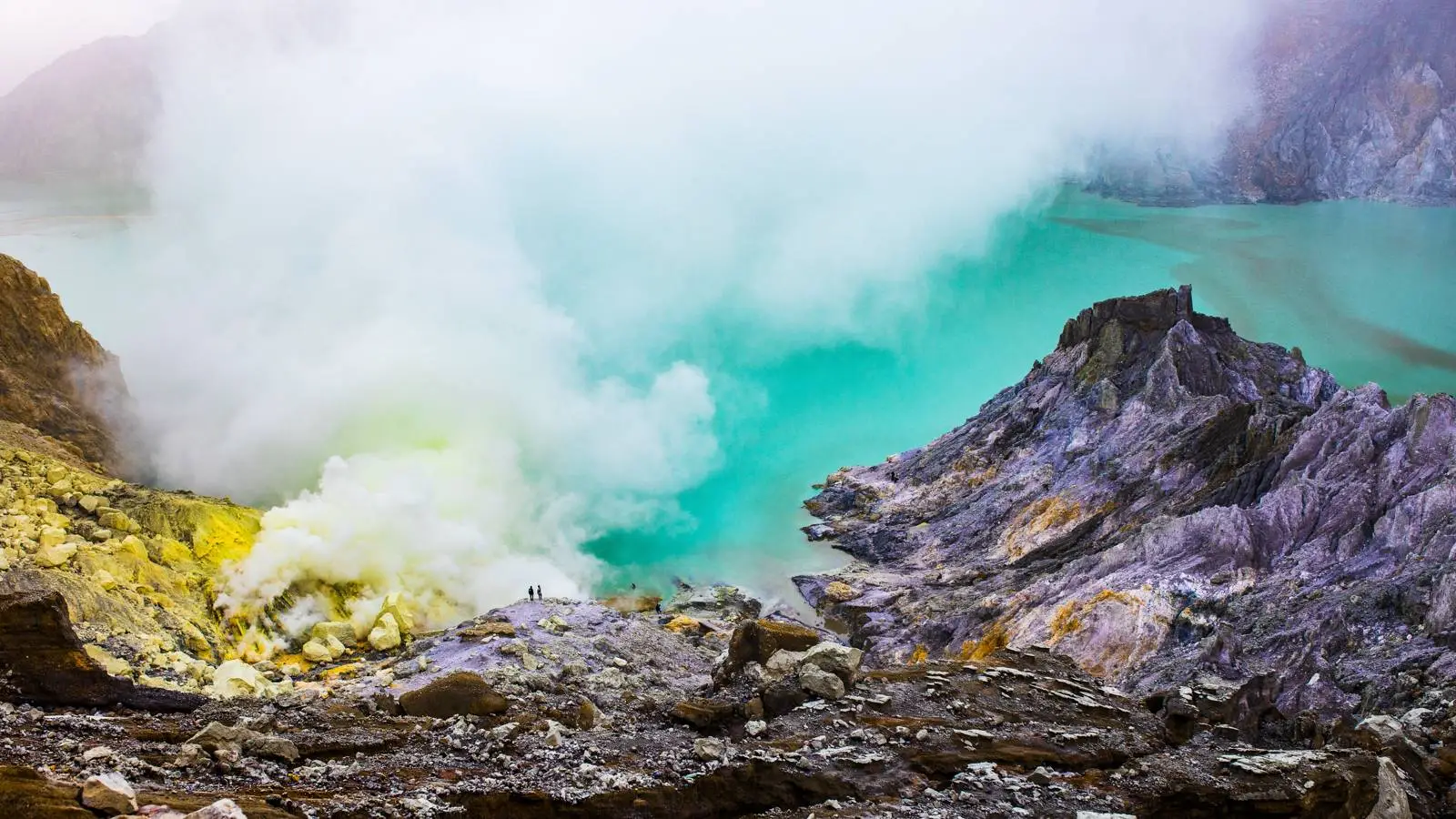
Inside the crater lies a large, bright-turquoise lake. Its water is so acidic that it rivals battery acid. Swimming is out of the question, of course—but the view is undeniably striking.
To reach the vantage point, hikers follow a designated trail up the mountain. Most start around midnight to arrive at the crater between 2 and 3 a.m.—the sweet spot for seeing the flames at their best.
The walk isn’t a breeze, and you’ll be climbing in the dark. Masks or respirators are essential: the air carries gases that can cause coughing and a burning sensation in the throat. Still, the payoff is memorable—a volcano slope glowing against the night.
Deep in the crater, local workers toil every day, extracting sulfur by hand—a substance used, for example, in fertilizer production. They work with minimal protection and haul heavy loads themselves. It’s dangerous, grueling labor, yet for many it remains the only way to earn a living.
As of 2025, the volcano is open to tourists. It remains active, but there is currently no danger for visitors. Before you go, it’s wise to check official sources for updates—trails are sometimes closed temporarily due to volcanic activity.
Ijen’s UNESCO geopark status also supports the growth of eco-tourism here: safety is monitored, and preserving the landscape is a clear priority.
Ijen is one of the few places on Earth where you can witness a flame of an otherworldly blue hue. It isn’t a camera trick or an illusion—it’s a genuine natural wonder. Add to that the extraordinary acid lake and sweeping mountain scenery, and the experience lingers long after you leave.
The blue fires don’t burn around the clock, won’t show up on command, and stay invisible in daylight. But arrive at the right moment, and the scene is one you won’t forget.