
Discover why people settle in volcanic craters and near active volcanoes: from Italy's Campi Flegrei to Indonesia's Sinabung—risk, fertile soil, safety myths.
It can feel unbelievable that anyone would choose to live inside a volcano. We tend to picture them as places on the brink of catastrophe. Yet in some countries people not only settle nearby—they build homes inside old craters.
Why do they do it? What does everyday life look like next to a giant like that? And what keeps them there despite the risk?
First, a bit of clarity. A crater is a depression at a volcano’s summit. After powerful eruptions, vast basins can form—these are called calderas. Over time, such places can resemble ordinary valleys: greenery, villages, vegetable patches.
That’s where people most often live—not amid flowing lava, of course, but inside the larger footprint of a volcano, in the place where it once raged.
One of the most vivid examples is the Campi Flegrei area near Naples, a huge depression left by an ancient eruption. Residential neighborhoods lie there, including the city of Pozzuoli. People have lived here for a long time even though there is still movement underground.
At times the ground rises or sinks, mild tremors occur, and steam and gases seep from cracks. Scientists keep watch, noting that activity has intensified in recent years. Even so, locals stay: this is home, daily life is set, the soil is rich, and the location is convenient. Housing in such areas also tends to be cheaper.
Indonesia is a country where volcanoes are nearly everywhere. By some counts, about 75% of its population lives within 100 kilometers of a volcano. For many, even that isn’t distant enough—they build right next to active ones.
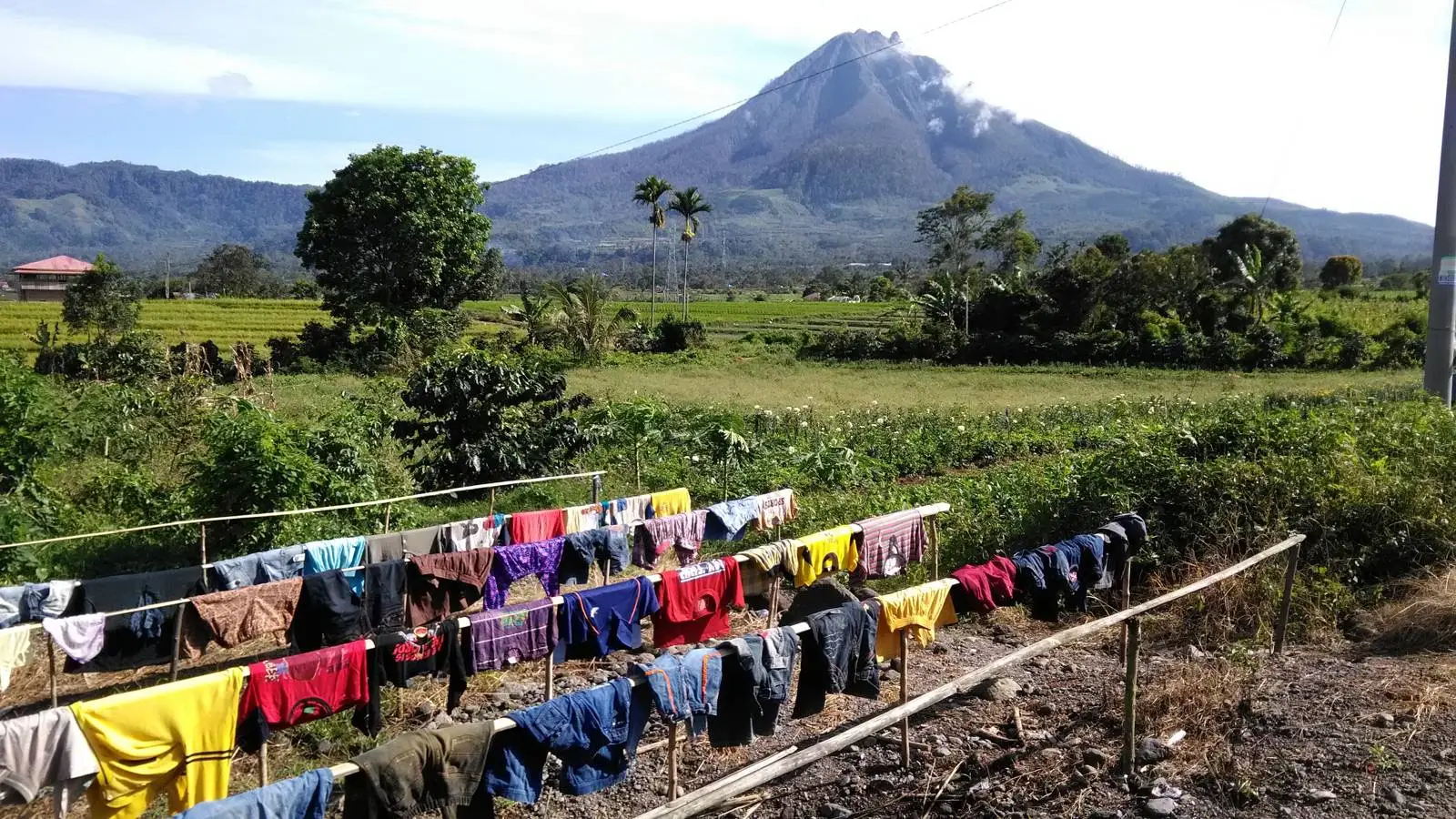
On the island of Sumatra sits Mount Sinabung. It was quiet for a long time, but in recent years it has often stirred. There have been eruptions, ash fall, evacuations. And still people return. They leave—and then come back. Why? Because it’s their land. They grow vegetables, graze livestock, and live ordinary lives. Many have a plan for what to do if an eruption begins, and over time they simply get used to sharing a landscape with a volcano.
At first glance, living near a volcano seems dangerously reckless. Yet these places have advantages: fertile soil, a favorable climate, and a familiar environment. For many, this is more than a dot on the map; it’s home. The threat can feel distant and abstract, especially when there aren’t many alternatives.
Despite dramatic headlines, there’s no reliable evidence that people live inside an active crater—it would be far too hazardous. Most settle in safer parts of old craters or on the surrounding slopes.
That postcard image of a cottage on the crater floor is likely just a beautiful fantasy. Life in such unusual places does exist, just not at the very heart of the fire.
Scientists pay close attention to volcanic activity, especially in densely populated regions. Even when warnings are issued, many are in no rush to leave. Habit, deep roots, and a belief that things will be fine all play their part. It’s hard to fault that logic when everyday life is already built around the land.
For residents of volcanic regions in Italy and Indonesia, this isn’t an exotic choice—it’s simply life. Some were born there, some built a house, others run farms—and they carry on despite the risk.
It’s difficult and risky, yet in its own way reasonable. The soil bears crops, the air feels clean, the houses have stood for decades. And if the volcano is quiet, why move? People live much as their ancestors did—with caution, and with the steady confidence that things will turn out well.
While the volcano sleeps, life goes on.