Discover Ethiopia's coffee ceremony - from roasting beans to the three cups of Abol, Tona, and Baraka. Learn its meaning, etiquette, tools, and role of women.
In Ethiopia, coffee is far more than a drink. It is woven into daily life, a meaningful reason to gather, and a sign of respect for guests. The coffee ceremony is a special ritual that brings together families, neighbors, and even strangers. What matters is not speed, but attention to one another; it feels less like service and more like a shared pause.
Ethiopia is widely considered the birthplace of coffee. A well-known legend tells of a herder named Kaldi who noticed his goats became unusually lively after eating berries from a certain shrub. People grew curious, began to experiment, and over time learned to roast and brew coffee beans.
From there, coffee gradually became part of the country’s routine. It is not only about taste or alertness: over a cup, people discuss the news, make peace after quarrels, and exchange stories and experience. The coffee ceremony evolved into a familiar, shared way to communicate—almost a language of its own.
The Ethiopian coffee ceremony is a full process that can last two, even three hours. It is most often hosted by women.
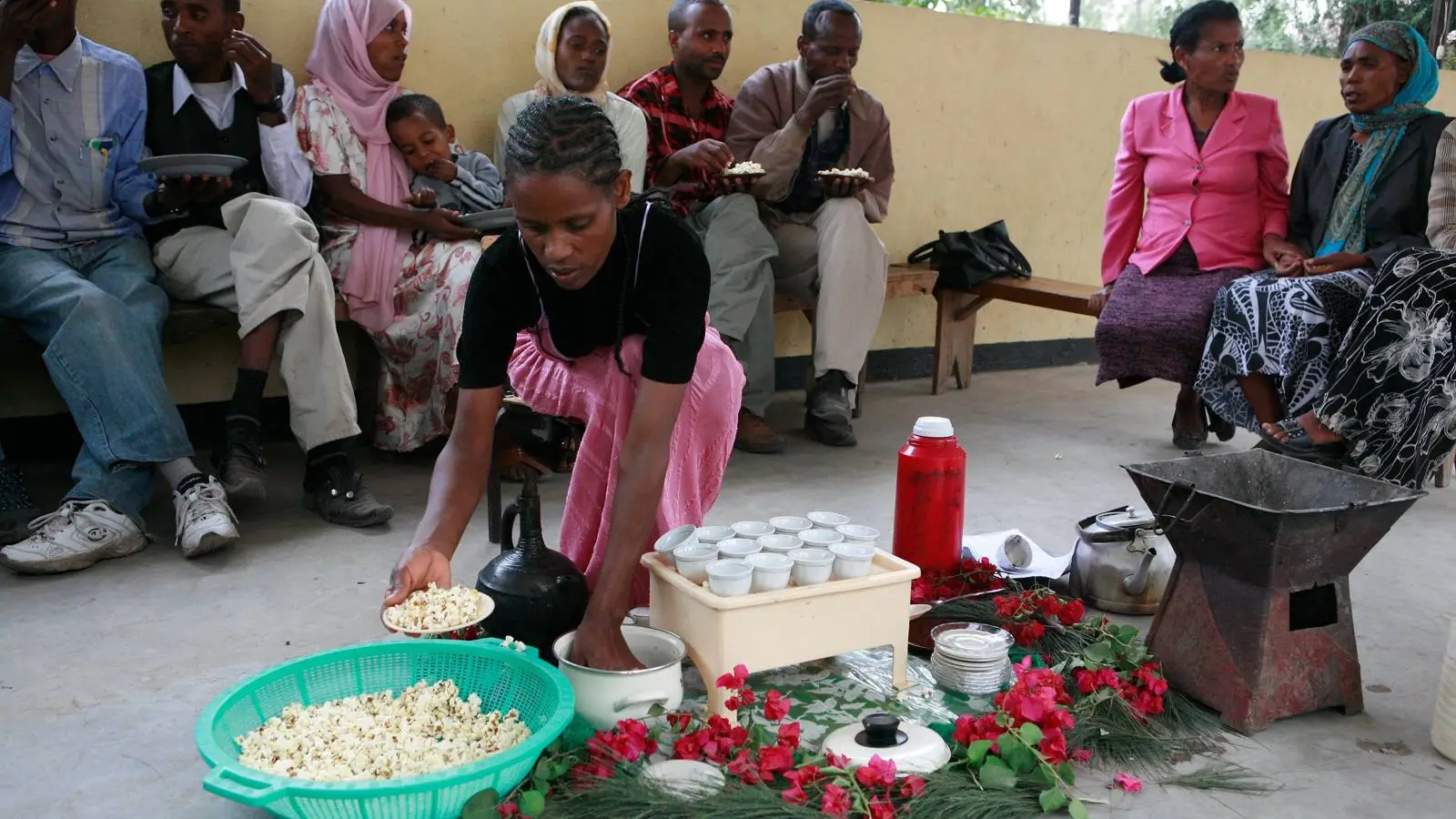
It begins with preparing the space. Fresh grass or flowers are laid on the floor, and incense is lit. This creates a calm, welcoming atmosphere and gently steers guests toward an unhurried conversation.
Green coffee beans are then washed, dried, and roasted on a metal pan right in front of the guests. The aroma of freshly roasted coffee is a key part of the experience. After that, the beans are ground by hand, typically in a wooden mortar.
The coffee is brewed in a special clay pot called a jebena. It has a round base, a narrow neck, and a curved spout. The drink is brought to a boil several times before being poured into small handleless cups called sini. Simple snacks often accompany the coffee: roasted barley, popcorn, or nuts.
During the ceremony, coffee is served three times:
It is believed that refusing the third cup is seen as a sign of disrespect to the hosts.
To visitors, the length may seem unusual, but for Ethiopians that is the point.
First, everything is done by hand and without haste. Guests witness each stage and feel part of what is unfolding.
Second, the ceremony is a moment for conversation. People talk, share news, joke, and discuss important matters. Coffee is the reason to gather, not the finish line.
Finally, every step carries meaning. The first cup is a greeting, the second continues the exchange, and the third offers a kind wish of well-being. Skipping a step would feel like ending the conversation mid-sentence—this cadence gives the meeting its rhythm.
The core elements are simple and constant:
Together, they signal respect for tradition and for the guests.
Women traditionally host the ceremony. They not only prepare the coffee but set the tone, sustain the conversation, and bring everyone in. Children are often nearby; they watch, learn, and gradually take on the tradition themselves.
In this way, the ceremony becomes a way to pass experience from elders to the young. Family stories are told, life lessons are shared, and common values take shape.
In big cities and tourist areas, the ceremony sometimes moves faster. Certain steps may be shortened, and a metal pot can replace the clay one. Yet the essence holds: coffee is still drunk together, in company, over conversation. Even when the pace quickens, the heart of the ritual stays intact.
Despite the pull of modern life, the coffee ceremony remains an important part of Ethiopian culture.