
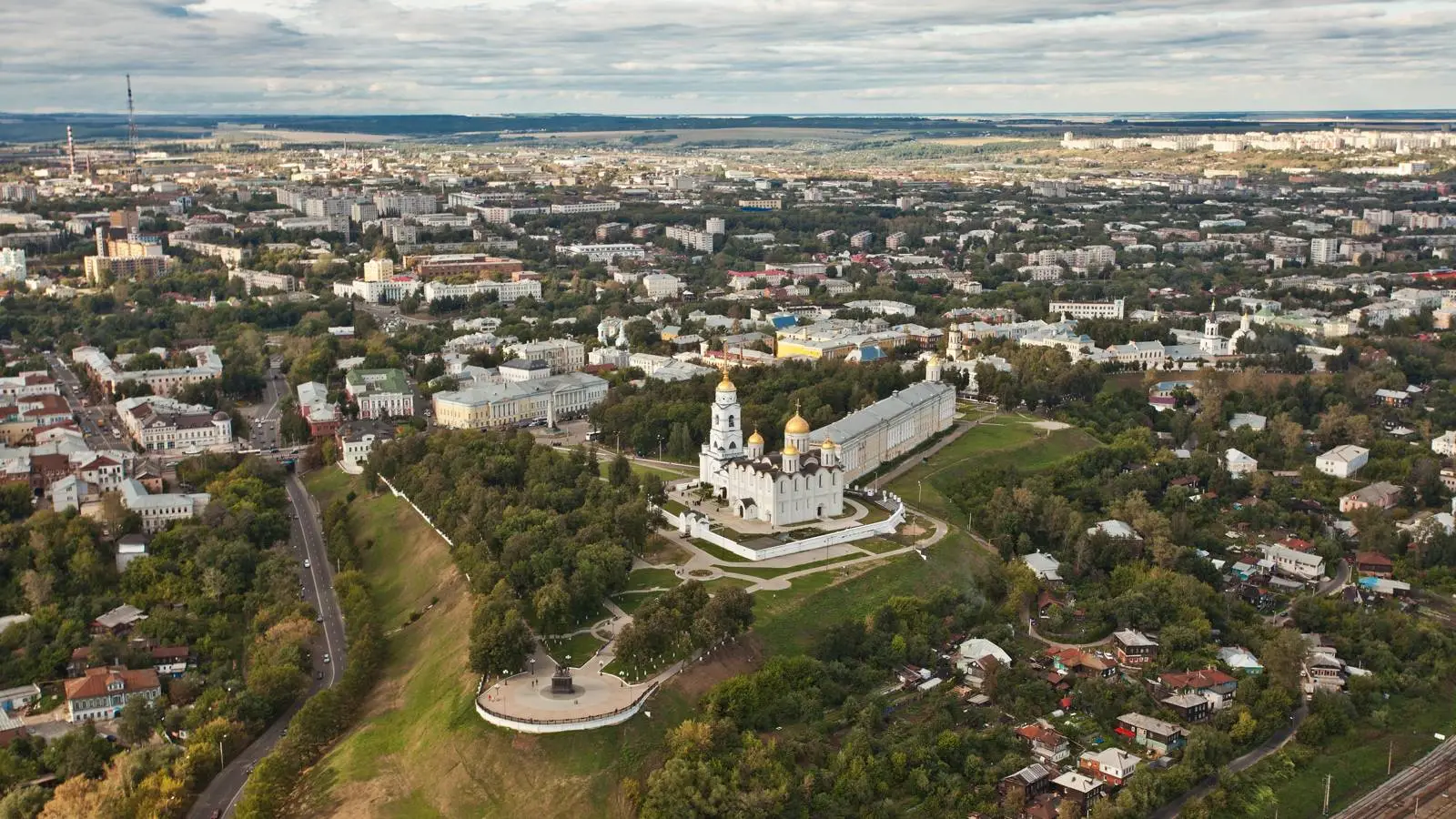
Discover why Vladimir's city center is a street, not a square: from three hills to Catherine II's grid and today's plans, history still shapes its urban rhythm.
The center of a city is usually a square: broad, open, with a monument, a fountain, maybe pigeons. Around it sit important buildings, shops, and cafés. Vladimir breaks that pattern. Here, the heart of the city is a street — not a square — and there are solid reasons for that.
Vladimir stands on the bank of the Klyazma River and once stretched across three hills. These hills — Pecherny, Vetshany, and Novy Gorod — were like distinct parts of the settlement. Ravines and changes in elevation lay between them, so it made sense to tie everything together with a road that ran through the entire city. That is how the main street emerged.
It became the city’s backbone. As early as the 12th century, life clustered along it: trade, building, movement. The most important structures stood here, and the urban rhythm revolved around this line. It’s easy to see why the route that connected everyday life turned into the organizing axis.
In the 18th century, during the reign of Catherine II, Vladimir began to be rebuilt. The goal was order: straight streets and clear blocks. In 1781, a plan was approved that set most streets perpendicular to the main one — the very route that had existed since ancient times.
A large central square did not appear in that design. The reason was straightforward: hills, ravines, and the terrain made a spacious open site impractical. The longitudinal street, meanwhile, was in the right place and kept its primacy. That choice still looks sensible.
Even in 2023–2024, as the city gets a refresh, the authorities lean on that same street. Official information highlights new projects focused on the center. Streets are being repaired, new small parks and green pockets are added, yet the main direction remains — everything holds to one guiding line.
Urban planning documents still designate this street as central. Even as Vladimir has grown, the historic core retains its weight, and its layout endures.
Even if you have never been to Vladimir, the point is clear: history shapes how cities look and feel. Vladimir shows how natural conditions and age-old routes can decide where a city’s center will be.
Here, the center is not a broad open plaza but a street walked for centuries — first by people and carts, later by cars and trolleybuses. Buildings, churches, and shops lined up along it. It reads like a thread stitching the past to the present.