
Discover Bhavai, the balancing dance from Rajasthan and Gujarat, India. Explore its village roots, music, costumes, and efforts to preserve this tradition.
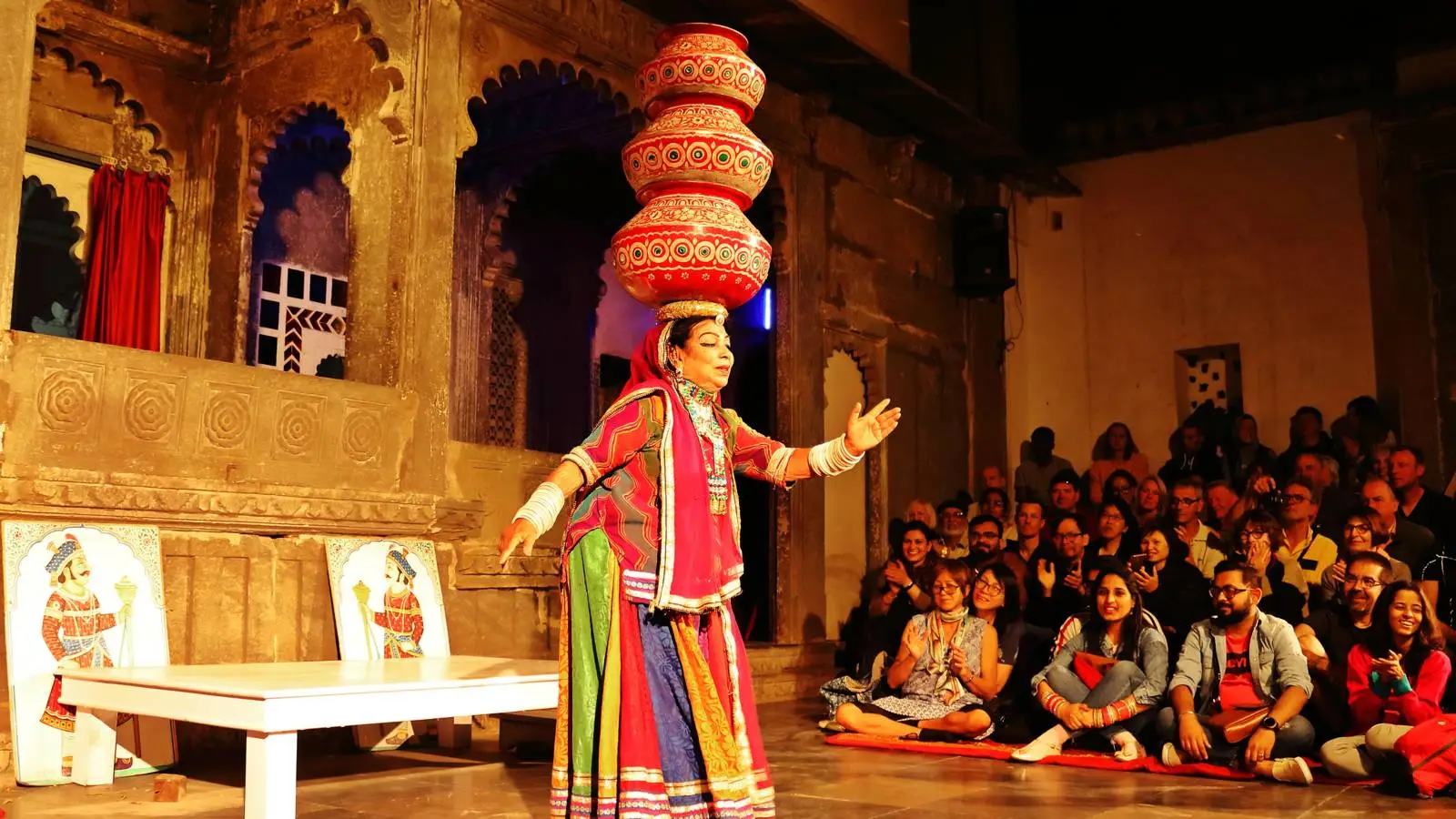
Some dances dazzle with sumptuous costumes, others with sheer kinetic energy. But there is one tradition from India that stops you in your tracks: Bhavai. A woman steps onto the stage, stacks pots on her head—one after another—and begins to dance. Sometimes she does it while standing on the edge of a sword, on glass, or even on the rim of a metal bowl. It is not a circus stunt, but a living strand of culture handed down in India from generation to generation.
This dance did not emerge in theaters; it grew out of village life. In India’s hot, arid regions, such as Rajasthan, women would walk daily to collect water and carry the pots home balanced on their heads—often not just one pot, but a whole tower of them. That necessity honed balance and dexterity.
Over time, that everyday skill turned into performance. Bhavai began to appear at festivals and celebrations. Today it can be seen in Rajasthan and in neighboring Gujarat. Each region brings its own touch, but the essence is the same: women dance with pitchers poised on their heads, displaying astonishing control and quiet resolve.
It usually starts with a single pot. Then comes a second, a third… sometimes eight or even nine. The dancer does not stand still; she moves, glides, turns, even sinks into gentle squats. At times she performs while balanced on a sword’s edge or on glass.
She wears bright traditional attire: a long, flared skirt shimmering with sequins and tiny mirrors, a short blouse, and a flowing scarf. Everything catches the light, and it is hard not to hold your breath at each measured step.
The music is live—drums, stringed instruments, and vocals. Folk songs often set the tone, carrying stories and feelings.
At first glance, Bhavai may look like a beautiful spectacle. In truth, it carries a deeper message. It mirrors the endurance and strength of Indian women, their ability to shoulder demanding routines while remaining composed and graceful.
Balance here is more than physical. The dancer bears a delicate structure on her head, yet she smiles and moves with ease—a quiet metaphor for staying steady even when life is unyielding.
Sadly, performances like this are becoming rarer. Many young people gravitate toward modern careers and entertainment, and Bhavai now appears mostly at festivals and cultural events.
There is good news, though. In 2025, efforts began in India to document and safeguard Bhavai—recording videos, collecting performers’ stories, and studying its traditions. That work can keep the art from fading away.
Performers have also taken the dance beyond India—to Australia and New Zealand, for example—suggesting that interest is very much alive and that Bhavai has a future.
Even if a trip to India is not on your calendar, discovering Bhavai is an easy way to connect with the country’s culture. Watch a video, browse a photo gallery—it’s hard not to be amazed.
This dance says a great deal: about women’s strength, about mastery, and about how art can grow from the ordinary. And it simply inspires. After all, dancing with nine pots balanced on your head is, frankly, astonishing.