
Discover Lonar Lake in Maharashtra, India: a rare meteor impact crater with saline-alkaline waters, unique microbes, ancient temples, and protected wildlife.
Imagine a place where space has literally left its imprint on Earth. This isn’t science fiction but a real spot in India, in the state of Maharashtra: the remarkable Lonar Lake. Formed by a meteorite impact, it’s still regarded as one of the country’s most unusual natural wonders.
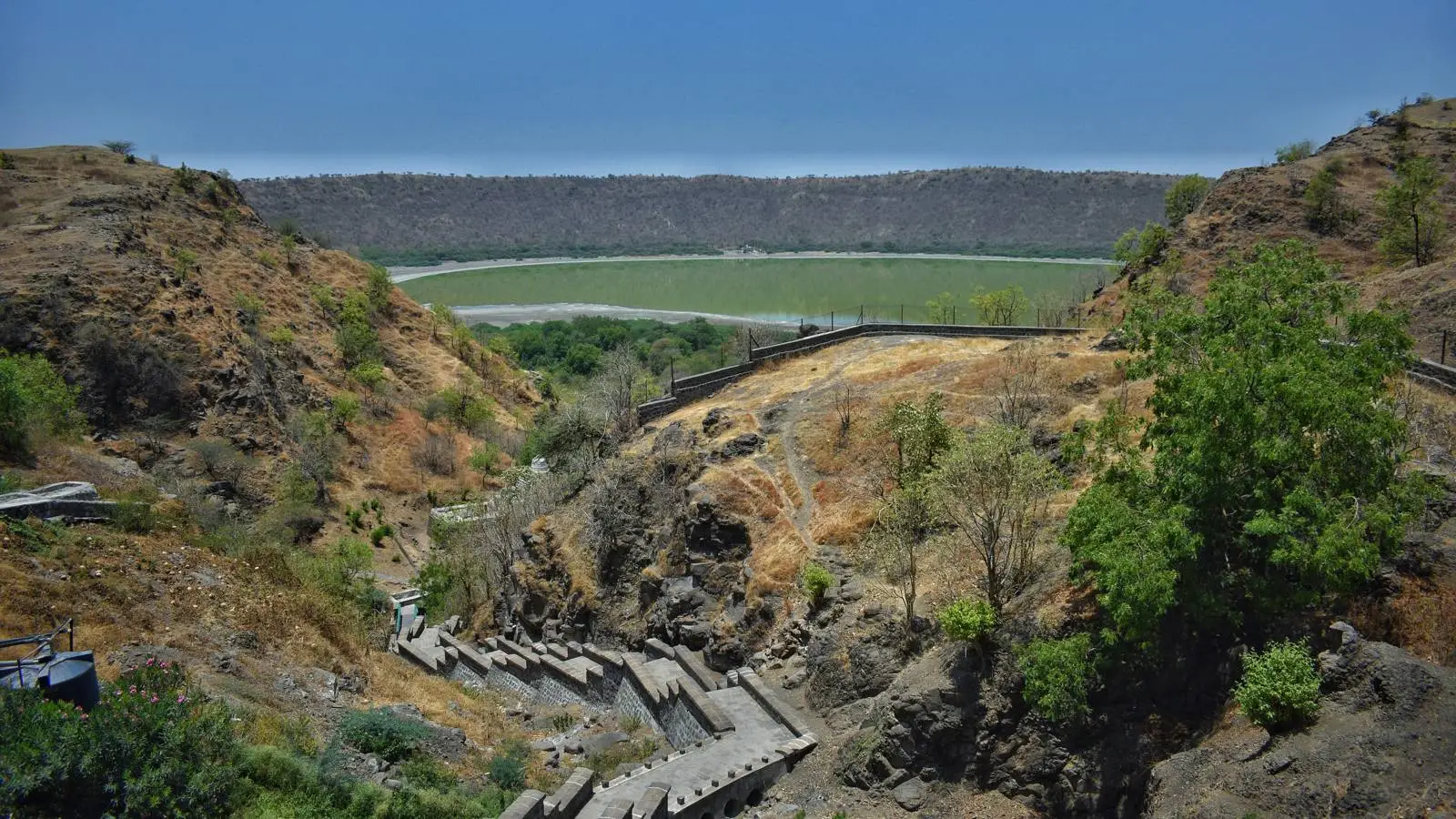
Thousands of years ago, a meteorite slammed into the ground at tremendous speed. It punched through hard basalt rock and carved out a vast crater. Over time, water filled the depression, giving rise to Lonar Lake. The basin measures about 1.2 kilometers across and plunges to more than 130 meters deep.
Scientists still debate the timing of the impact. Some argue it happened around 52,000 years ago, while others suggest it could date back as far as 570,000 years. What’s clear is its rarity: craters formed in basaltic rock like this have not been found elsewhere on Earth. It’s easy to picture the moment of impact—and just as easy to see why the site commands attention.
Unlike typical freshwater lakes, Lonar is both saline and alkaline, rich in soda. That mix stems from local geology and the fact that the lake isn’t connected to other bodies of water—whatever flows in tends to stay. The result is a harsh environment where only select forms of life endure.
Even here, nature adapts. The water harbors specialized microorganisms rarely seen elsewhere. Researchers study them to better grasp how life might function under extreme conditions, including worlds as unforgiving as Mars. The idea feels bold, but the evidence in Lonar’s waters makes it compelling.
Despite the lake’s unusual chemistry, the crater’s rim and surroundings are alive with trees, birds, and small animals. The area is officially recognized as a natural monument and protected by the state. It’s also counted among globally important natural sites thanks to its one-of-a-kind ecosystem.
Protecting such a place is no simple task. There have been no reports of serious threats over the past year, yet climate change and human impact could test the lake’s resilience in the future. For a landscape shaped by a cosmic blow, its balance still feels surprisingly delicate.
Lonar’s story is cultural as well as natural. According to legend, a demon named Lonasur was defeated here—hence the name. Centuries-old temples still ring the lake, adorned with intricate carvings, each one a fragment of India’s deep past.
Pilgrims and travelers continue to visit, though the place remains off the radar for many. That quietness adds to its pull, as if the crater has been keeping time in its own way for ages.
Lonar doesn’t demand a plane ticket to leave an impression. Its story alone resonates: a direct link between Earth and space, between what was and what is. Few places make that point so clearly—an enduring reminder of just how astonishing our planet can be.