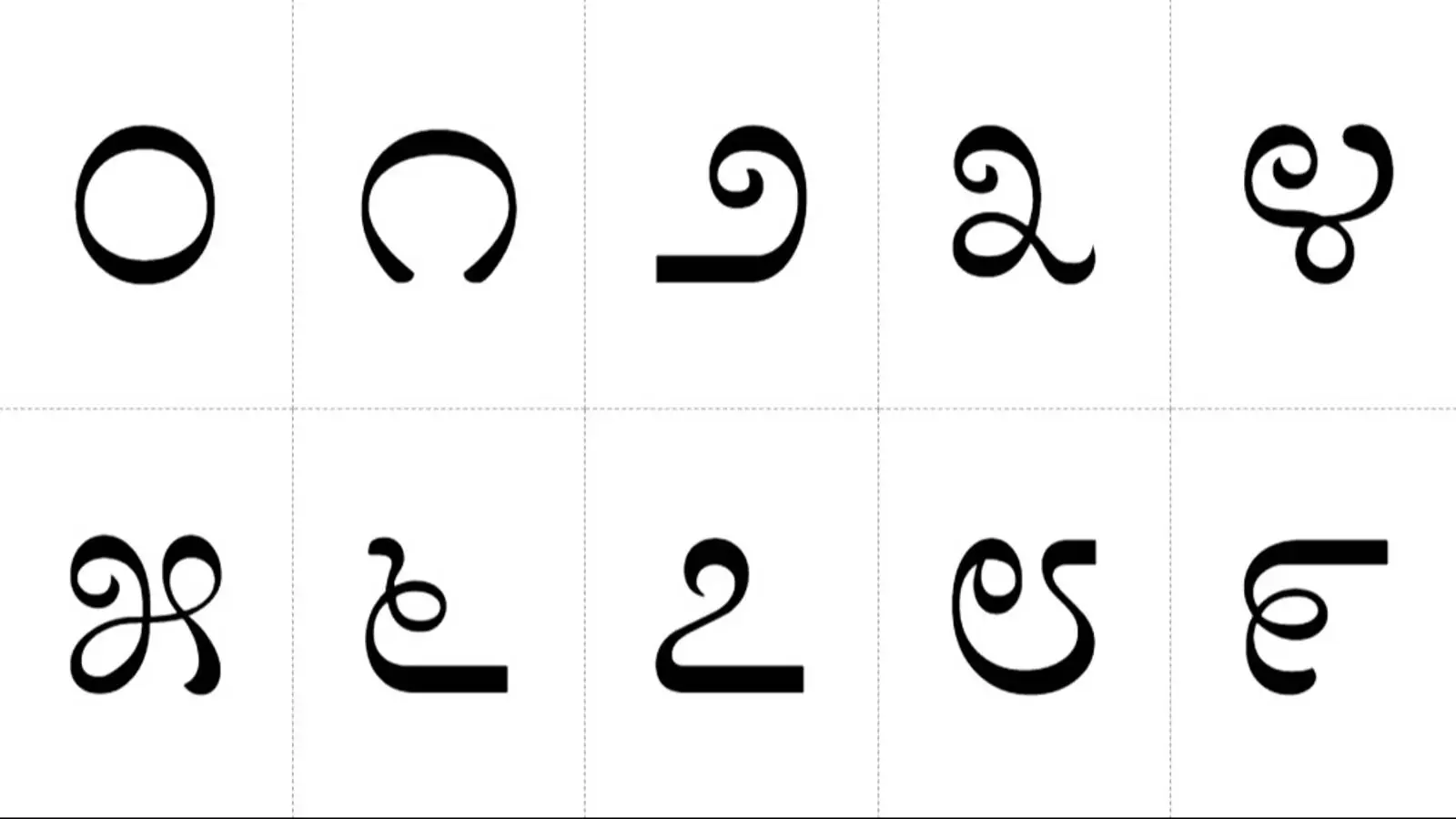
Discover how zero emerged in ancient India, from Brahmagupta’s rules to Aryabhata’s place-value, igniting the decimal system that powers math and technology.
Imagine being unable to write the number 205—simply because there is no zero. It sounds like a small omission, yet it sparked a genuine revolution that began in ancient India.
Thousands of years ago people already knew how to count. Egyptians, Romans, Sumerians—all had their own systems. But they lacked one crucial element: a symbol to mark nothing. If a number had no tens, how would you show it? In practice, you wouldn’t.
Those notations were awkward. Large values turned into unwieldy strings of signs, and errors came easily. Without zero, it was impossible to distinguish clearly between numbers like 25 and 205.
Everything changed in India. As early as the 3rd–4th centuries CE, scribes began using a symbol to indicate an empty place in a number. Evidence of this appears in an ancient text known as the Bakhshali manuscript.
The pivotal step came in the 7th century with the scholar Brahmagupta. He didn’t just mark nothing; he set rules for how to handle it—how to add, subtract, and multiply with it. Zero became a full-fledged number rather than a mere placeholder.
A little earlier, around the year 500, another Indian scholar, Aryabhata, championed a system where position mattered. The digit 2 could stand for two, twenty, or two hundred depending on where it sat. That laid the groundwork for what we now call the decimal system.
We use it every day: 10, 100, 1,000. It’s easy to write because each digit carries meaning based on its position. Zero signals that a number has no tens or hundreds while preserving units or thousands. Without it, the logic collapses.
This approach made calculation clearer and faster. Problems became easier to solve, records simpler to keep, and numbers shorter to write. Unsurprisingly, the method proved so practical that it spread across the world.
In the 9th century, Arab scholars encountered the Indian system. They adopted zero and positional notation and quickly saw how powerful they were.
From the Arab world the idea reached Europe. At first, some treated zero with suspicion, wondering how one counts nothing at all. But the advantages became undeniable, and eventually the world embraced the Indo-Arabic system—the very notation we use today.
At first glance, it’s just a small circle. In practice, it unlocked speed and precision in working with numbers. Without it, there would be no algebra, no computers, no internet. Even a bank account would be tricky to write down.
Indian scholars were the first to grasp that even nothing can be essential. They didn’t merely create a sign; they reshaped how we think about numbers.
Zero is more than a digit. It’s an idea that transformed mathematics, science, and the world we live in—and it took shape in India. Thanks to this notion of nothingness, we can tally millions, launch rockets, and write code. Sometimes, to start something great, you have to start from zero.